



National Law University Delhi (NLU Delhi) and Beihai Asia International Arbitration Centre Pte Ltd (BAIAC), Singapore, are delighted to announce the signing of a Memorandum of Understanding (MoU) to strengthen cooperation in the field of Alternative Dispute Resolution (ADR).
Under the MoU, both institutions will collaborate to organize workshops, seminars, webinars, conferences, training programmes, competitions, credit courses, publications, student internships, and mentorship initiatives, both online and offline. The agreement also aims to foster joint academic research, student and faculty exchange programmes, and other collaborative activities in ADR.
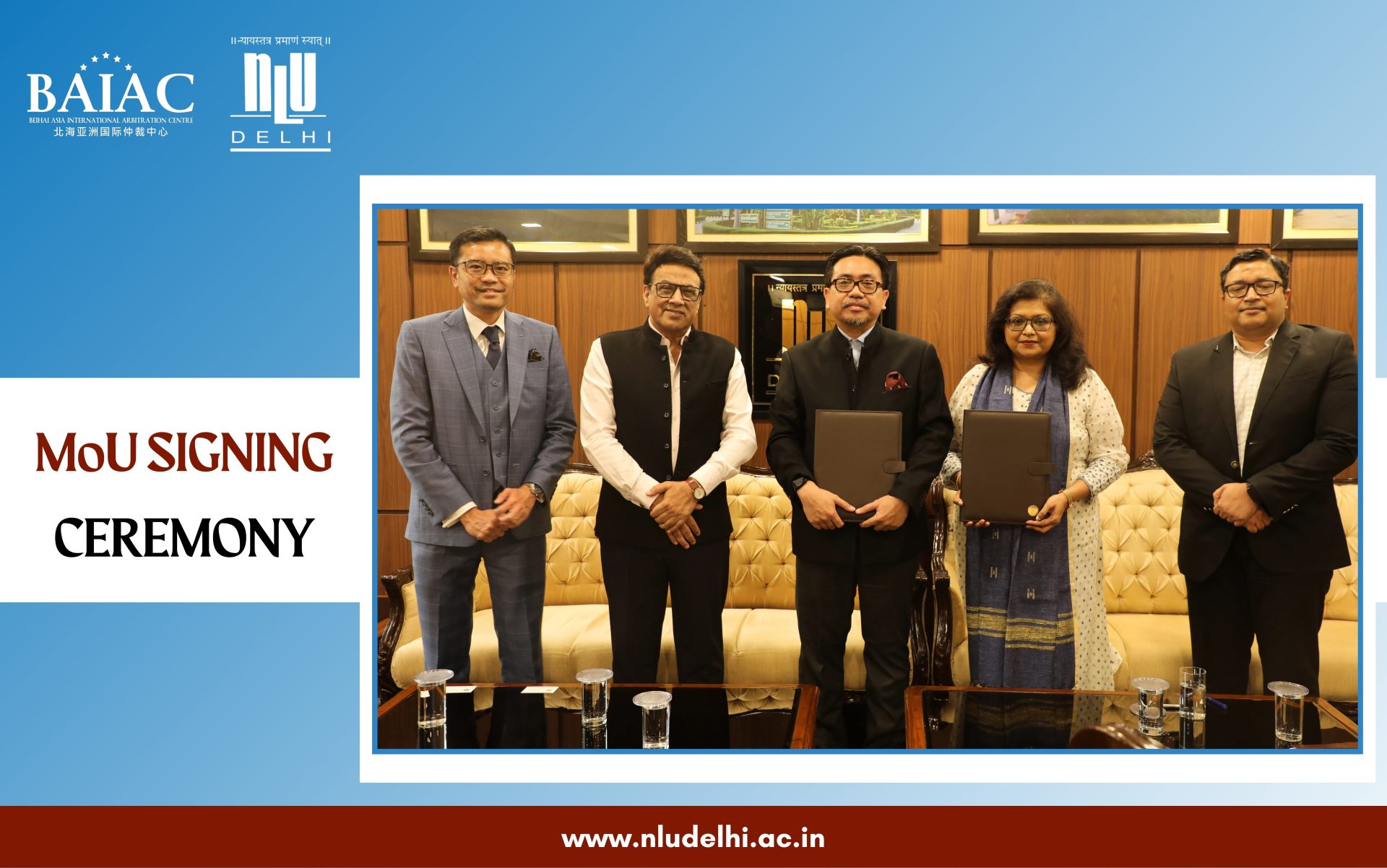
The MoU was signed by Professor (Dr.) Ruhi Paul, Registrar, NLU Delhi and Professor Steve Ngo, President and Executive Director, BAIAC, Singapore, in the presence of Professor (Dr.) G.S. Bajpai, Vice Chancellor, NLU Delhi, Dr. Daniel Mathew, Dean of International Relations, NLU Delhi and Alfred Lim, Managing Director, Meritus Law LLC, Singapore.
On the occasion, Professor (Dr.) G.S. Bajpai, Vice Chancellor, NLU Delhi, said:
“I am glad that the two institutions have now formalised their collaboration with the signing of this MoU. This will enable joint academic research, foster exchange of ideas, and encourage student and faculty mobility programmes. Through this partnership, NLU Delhi furthers its commitment to deepen international ties and explore global academic prospects.”
Professor Steve Ngo, said:
“We are very glad to partner with NLU Delhi as it is one of the leading law universities in India. Both Beihai Asia International Arbitration Centre (BAIAC) and NLU Delhi share the same values and commitment to academia, research, and social impact. A collaboration of this nature is mutually beneficial to both institutions, their faculty, and especially their students.”